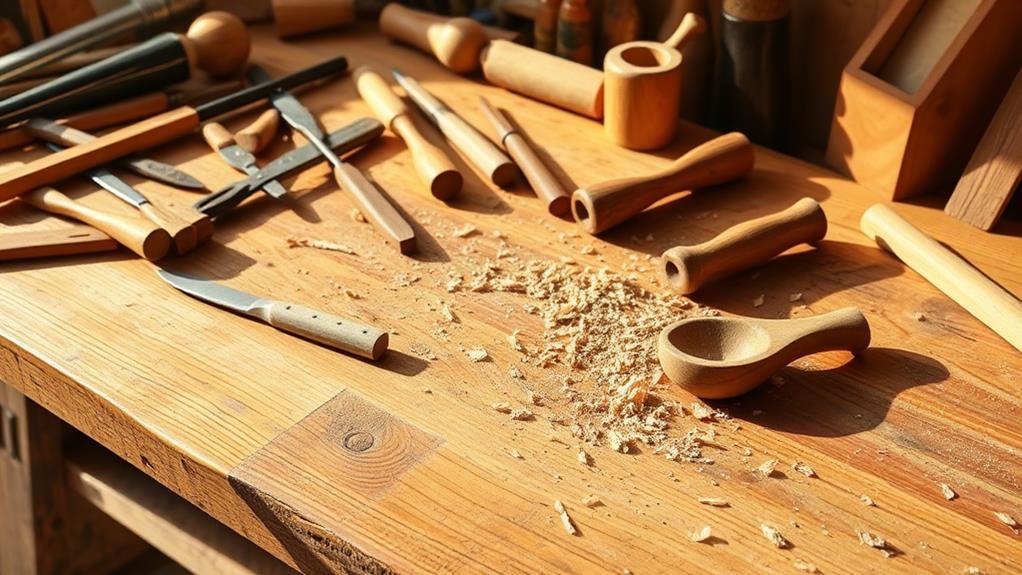
To get started with wood carving, you’ll need five essential wood carving hand tools. First, a carving knife is crucial for precision cuts. Next, a whittling knife offers control with its slender blade. Chisels are versatile for shaping wood, while gouges, particularly U-shaped or V-shaped, help create deeper designs. Lastly, a mallet enhances your control when using gouges. Choose a wooden or rubber mallet based on your project needs. Regular maintenance will keep your tools in prime condition, ready for any task. As you explore these tools, there’s much more to discover about techniques and best practices.
Table of Contents
Carving Knife
When it comes to wood carving, a carving knife is one of the most essential tools you’ll need in your kit. This tool allows you to execute a variety of carving techniques, from simple cuts to intricate details.
To get started, choose a knife with a comfortable grip and a blade that suits your projects. A good carving knife typically has a curved blade, enabling you to maneuver with precision.
Once you’ve selected your knife, focus on mastering different carving techniques. Practice controlled cuts, push cuts, and pull cuts on scrap wood to develop your skill. Always remember to carve away from your body for safety.
Knife maintenance is crucial for optimal performance. Regularly sharpen your blade using a honing stone or a fine-grit sharpening tool. Keep the edge clean and free of resin buildup to ensure smooth cuts.
It’s also wise to periodically oil the handle and blade to prevent rust and maintain the knife’s longevity.
Whittling Knife
A whittling knife is a specialized tool that every wood carving enthusiast should consider adding to their toolkit. Its slender blade, typically around 2 to 4 inches long, allows for precision and control, making it ideal for intricate whittling techniques.
When choosing a whittling knife, look for one with a comfortable handle, as this will enable you to maintain a steady grip during extended carving sessions.
To get started, familiarize yourself with basic whittling techniques such as slicing, pushing, and pulling cuts. Each technique requires a different angle of approach, so practice on scrap wood before attempting your main project.
Remember, using the right grip and stance will enhance your accuracy and reduce fatigue.
Safety tips are paramount when using a whittling knife. Always cut away from your body to minimize the risk of injury. Wearing a cut-resistant glove on your non-dominant hand can provide extra protection.
Additionally, keep your workspace organized to avoid distractions, and ensure your knife is sharp; a dull blade requires more force, increasing the likelihood of accidents.
With these guidelines, you’ll be well on your way to mastering the art of whittling.
Chisels
Chisels are essential tools for any wood carving beginner, offering versatility in shaping and detailing your projects.
Understanding the various chisel types is key to enhancing your craftsmanship. Here’s a quick overview:
- Straight chisels: Perfect for making clean cuts and straight lines.
- Bevel-edge chisels: Ideal for angled cuts and fine detail work.
- Mortise chisels: Designed for cutting deep, square holes.
- Paring chisels: Best for delicate and precise trimming.
- Skew chisels: Great for working in tight corners and intricate areas.
To get the most out of your chisels, proper chisel maintenance is crucial.
Keep your tools sharp by honing them regularly with a whetstone or honing guide. Always clean them after use to prevent rust and damage.
Store your chisels in a protective case to maintain their edges and ensure they’re ready for your next project.
By selecting the right chisel types and maintaining them diligently, you’ll unlock your potential as a wood carver and enjoy the journey of creating beautiful pieces.
Embrace the liberation that comes from mastering these essential tools!
Gouges
Gouges are indispensable tools in the wood carving toolkit, enabling you to create deeper cuts and unique shapes with precision. You’ll find various gouge types, including U-shaped, V-shaped, and spoon gouges, each designed for specific tasks. U-shaped gouges excel at hollowing out surfaces, while V-shaped gouges are perfect for creating fine details and sharp lines. Spoon gouges, with their curved blades, work wonders for shaping concave areas.
To master gouge techniques, start by firmly holding the tool with a comfortable grip. Position your hands to maintain control, allowing your wrist to guide the gouge smoothly through the wood. Experiment with different angles and pressures to achieve the desired effect.
For deeper cuts, maintain a steady motion and use the gouge’s curve to your advantage, allowing it to naturally follow the grain of the wood.
Practice makes perfect, so carve a few practice pieces to develop your skills. As you gain confidence, you’ll unlock the potential of gouges, transforming your wood carving projects into intricate works of art.
Embrace the freedom that gouges provide, and let your creativity flow!
Mallet
To effectively utilize gouges and achieve the desired depth and detail in your wood carving, a mallet becomes an invaluable companion. The right mallet not only enhances your control but also allows you to work with precision.
You’ll find various mallet types, each suited for different tasks, ensuring you can tackle any project.
- Wooden Mallets: Classic choice, providing a solid strike without damaging your tools.
- Rubber Mallets: Great for softer woods, these minimize shock and are quieter.
- Plastic Mallets: Durable and versatile, perfect for transitioning between various materials.
- Metal Mallets: Offer more power for harder woods, but use them with caution to prevent tool damage.
- Adjustable Mallets: Allow for customizable weight and balance, catering to your specific needs.
When selecting a mallet, consider the mallet materials as they influence both the impact and the feel.
Wooden mallets are traditional and effective, while rubber and plastic options provide unique advantages for specific projects.
Frequently Asked Questions
How Do I Maintain My Wood Carving Tools?
To maintain your wood carving tools, regularly clean them after use, apply a rust prevention oil, and store them in a dry, well-ventilated area. Consider using padded cases for optimal tool storage solutions to prevent damage.
What Types of Wood Are Best for Beginners?
Did you know that about 80% of beginner wood carving projects use softwoods? For ease of carving, choose basswood or pine. While hardwoods offer durability, softwoods provide a smoother experience, making them ideal carving wood types for novices.
Is It Necessary to Wear Safety Gear While Carving?
Yes, it’s crucial to wear safety gear while carving. Proper safety practices ensure injury prevention, protecting you from potential accidents. Don’t underestimate the importance of gear; it’s essential for a safer, more enjoyable carving experience.
Where Can I Find Beginner Wood Carving Projects?
You can find beginner project ideas on woodworking websites and forums. Look for easy carving patterns in books or online tutorials. These resources will guide you through simple designs, helping you build confidence and skills.
How Do I Sharpen My Carving Tools Effectively?
To sharpen your carving tools effectively, visualize a blade’s edge transforming like a butterfly emerging from its chrysalis. Employ honing methods and sharpening techniques, ensuring you maintain the correct angle for precision and lasting sharpness.
Conclusion
In conclusion, equipping yourself with these five essential wood carving tools is like having a sturdy compass on a journey—you’ll navigate the craft with precision and confidence. Each tool serves a unique purpose, allowing you to explore various techniques and styles. As you practice and develop your skills, you’ll find that these hand tools become extensions of your creativity. So, grab your carving knife, whittling knife, chisels, gouges, and mallet, and let your artistic journey begin!